Agha Reveals SKY Shook His Hand in Private While Refusing in Public. Here Is What He Said and Why It Matters.
Pakistan captain Salman Ali Agha broke his silence after the Asia Cup 2025 final, claiming Suryakumar Yadav shook his hand privately at the pre-tournament press conference and referee meeting but refused in front of cameras. He also addressed the trophy incident and called India's conduct disrespectful to cricket.
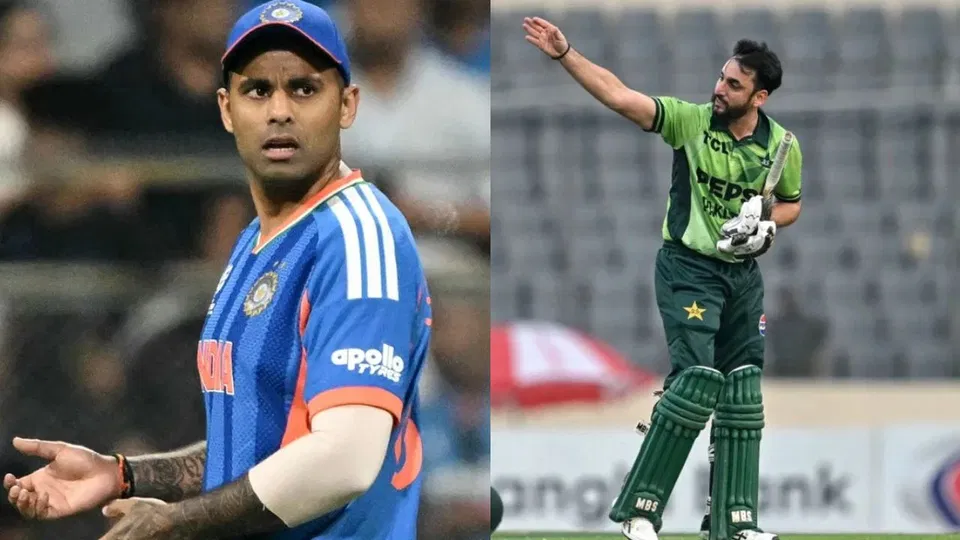
India won the Asia Cup final. India refused to shake hands. India refused to collect the trophy from Mohsin Naqvi. Then India went into the changing room before Pakistan could even attempt the handshake.
Pakistan captain Salman Ali Agha had been in a volatile press conference for a few minutes when he said something that cut through all the noise. Suryakumar Yadav, he claimed, had shaken his hand in private, twice, during the tournament. Once at the pre-tournament captains' press conference. Again at the referee's meeting before the final. Just not in front of the cameras. Not where the public could see it.
“He shook hands with me in private at the start of the tournament, both at the pre-tournament press conference, and when we met in the referee's meeting. But when they're out in the world in front of the cameras, they don't shake our hands. I'm sure he's following the instructions he's been given, but if it was up to him, he'd shake hands with me.”
That single claim reframed the entire debate.
What Agha Was Responding To
India had just beaten Pakistan by five wickets in the Asia Cup 2025 final in Dubai. From the moment the last wicket fell, the tensions that had been simmering since the Pahalgam terror attack in April came to the surface. India's captain had confirmed before the match that the no-handshake policy would continue, citing the Pahalgam victims and solidarity with the Indian Army following Operation Sindoor.
After the match, Pakistan's players went over to shake hands. India had already gone into the changing room. Pakistan coach Mike Hesson said he was “disappointed.” Agha skipped the post match presentation entirely. Match referee Andy Pycroft then became a focal point of a formal PCB protest, with the board claiming he had pulled Agha aside before the toss to tell him that India would not be shaking hands at the toss. The PCB asked the ICC to remove Pycroft from the tournament. The ICC declined.
When Agha finally emerged for the press conference, he was direct. “What India have done this tournament is very disappointing. They are not disrespecting us by not shaking hands, they are disrespecting cricket. Good teams don't do what they did.”
The Trophy Incident
Alongside the handshake row, the trophy presentation added another layer. Asian Cricket Council chief and PCB chairman Mohsin Naqvi was on the presentation dais. India declined to collect the trophy while Naqvi was standing there. Naqvi then left with the trophy. India celebrated on the podium only after the officials had cleared the area. The image was exact: India's players waiting on the field while officials negotiated over a trophy nobody had yet collected.
Agha defended Naqvi's decision to leave with the trophy. His logic was that it happened as a direct response to India not coming up to collect it. “Everything that happened today was a consequence of all that happened before. Of course, the ACC president will give the trophy to the winners.”
Whether you accept that explanation depends on how you read the sequence of events. The presentation ceremony did not go smoothly from the moment it began. Both sides made choices that afternoon that they were aware would generate headlines.
The Private Handshake Claim
The most substantive part of Agha's press conference was the claim about Suryakumar shaking hands privately while maintaining the public no-handshake position. Agha was not presenting this as a scandal. He was presenting it as evidence that SKY, personally, had no issue with him. The problem, in Agha's reading, was the institutional instruction SKY was operating under.
“I'm sure he's following the instructions he's been given, but if it was up to him, he'd shake hands with me.”
This matters because it shifts the conversation away from individual players and toward the institutional decision. India's no-handshake policy was confirmed by BCCI sources before the match and framed as a decision taken at the level of the board and Indian government in the aftermath of Pahalgam. SKY himself explained it at the presentation: “Few things in life are ahead of sportsman spirit also. We stand with all the victims of Pahalgam terror attacks.”
Agha was not disputing the sincerity of that position. He was drawing a distinction between what SKY did publicly and what he did when nobody was watching. Whether that distinction carries moral weight is a question the reader can answer for themselves.
Where Things Stand
The no-handshake policy continued into the ICC T20 World Cup 2026, where both captains again avoided the customary exchange at the toss in Colombo in February. India won that match too, by 61 runs. The handshake did not return. The debate did not go away.
Pakistan donated their match fees from the Asia Cup final to the victims of the Pahalgam attack, a gesture that Agha confirmed at the same press conference. It was one of several elements of that evening that got buried under the noise of the trophy and the handshake.
Cricket between India and Pakistan has always carried weight that extends beyond the game. This Asia Cup carried more than most. The press conference Agha gave that evening is one of the more revealing post-match statements of recent years, not because it resolved anything, but because it was honest about the parts that cannot be resolved on a cricket field.
Was India's no-handshake policy the right call, or did it cross a line between politics and sport that should not have been crossed?